Firstdark

Aurora & dark sky planner

Is tonight worth the drive?

Most aurora apps hand you a Kp number and leave the hard part to you. Kp 5 is a great night in Minnesota and nothing at all in Texas — the number means nothing until you know what your own latitude needs.

Firstdark works out that threshold from where you are standing, checks it against the forecast, the moon and the cloud across your actual dark hours, and answers in a sentence.

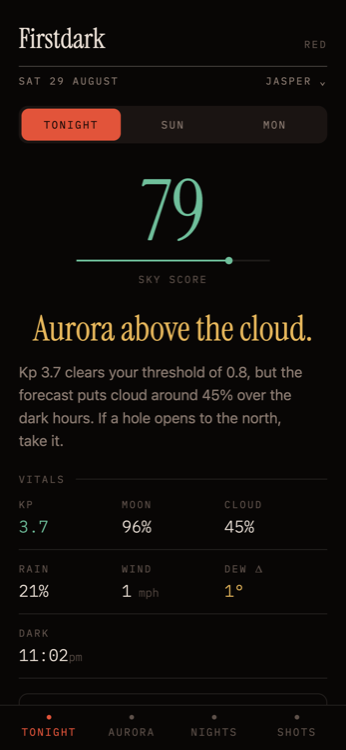
The Tonight screen: a sky score of 85 over Glacier National Park, the verdict
                  “Go. The sky says yes.”, and a row of vitals — Kp 3.7, moon 96%,
                  cloud 31%.

What it does


A threshold that is yours

The auroral oval sits at a geomagnetic latitude, not a geographic one — which is why Minnesota outperforms the same line of latitude in Europe. Firstdark computes your threshold from your coordinates, every time, and never reads it off a table.

Everglades: no aurora at any Kp. Fairbanks: you are inside the oval.

It tells you what it doesn’t know

Cloud runs out at sixteen days and Kp at three. Past that, other apps quietly show you a number anyway. Firstdark says the sky is unknown rather than clear, marks a 27-day recurrence estimate as the guess it is, and never counts one as a forecast.

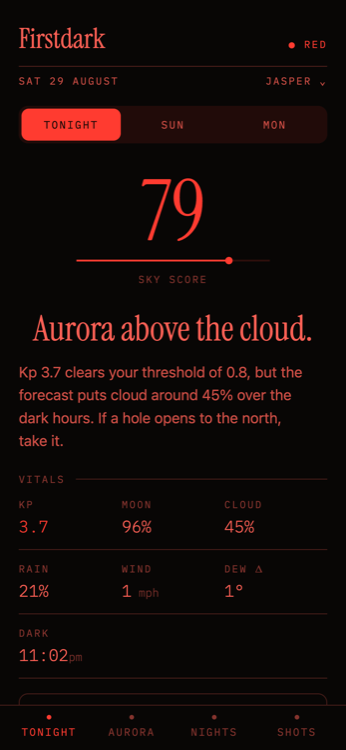
Red-light mode, all the way down

Not a filter over a white app. The entire palette swaps, and no white or green pixel survives it — so you can check the hour bars at 2am without spending twenty minutes getting your night vision back.

Works with no signal

Sun, moon, twilight and the galactic centre are computed on the device and need no network at all. Cloud and space weather are cached with their age shown honestly — “Kp forecast from four hours ago”, not a blank screen in a dark car park.

Eclipses, with your own circumstances

Every lunar and solar eclipse to 2050, from NASA’s catalogues. For a solar eclipse it computes what you would see from where you are standing — magnitude, obscuration, contact times — rather than naming the countries the path crosses.

Checked against NASA’s published circumstances for all 66 eclipses.

A report you can print

The screens answer one question at arm’s length in the cold. The report is the other half: twenty-eight nights, every ranked subject with its reasoning, and where each number came from — as a PDF to save, send or take with you on paper.

It learns your sky

The oval boundary is a rule of thumb, and no ephemeris can check it. After an alert, Firstdark asks whether you actually saw anything. A month of clear nights narrows the threshold to your own horizon, your own light dome, your own hills.

The four screens


Tonight: sky score 85, the verdict, and six vitals.

Tonight

One question, one answer, and the reasoning under it in a sentence you can read at arm’s length.

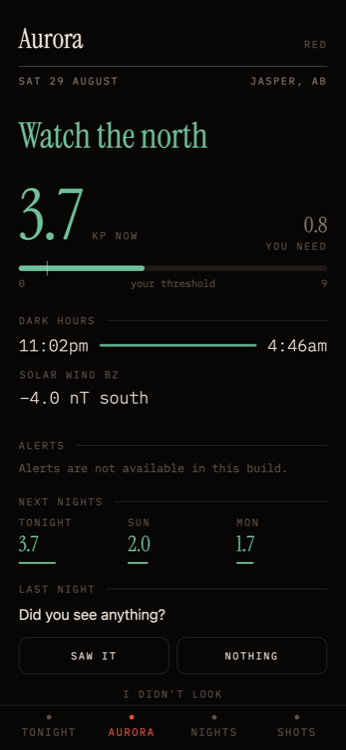
Aurora: Kp 3.7 against a threshold of 2.5, dark hours, and the solar wind Bz.

Aurora

Your threshold, not a national one — and the solar wind reading that says whether the next hour is worth waiting out.

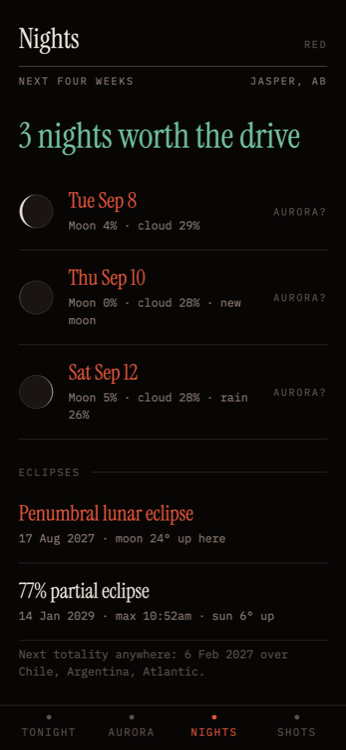
Nights: four nights worth the drive, with moon discs, and the next eclipses.

Nights

Four weeks ahead, narrowed to the nights that are actually worth it, with the eclipses that fall in range.

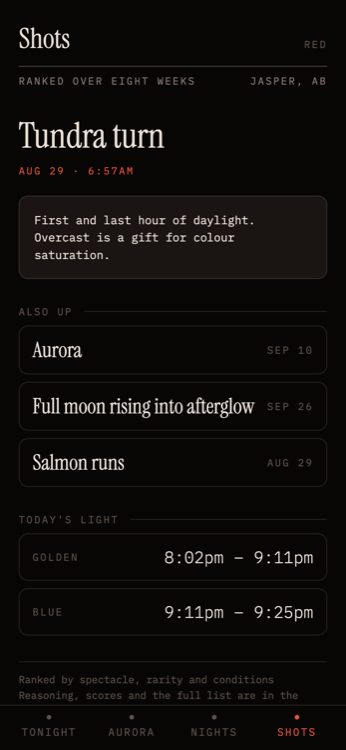
Shots: the aurora ranked first, with altitude, bearing and exposure settings.

Shots

What is up, where to point, and where the light falls — ranked over the next eight weeks.

Checked against


Astronomy that plans a night should be worth trusting, so it was measured rather than assumed — against the US Naval Observatory and JPL Horizons, over six sites from 25°N to 65°N.
QuantityTypical errorWorst case
Sunset0.5 min1.4 min
Civil twilight0.5 min1.3 min
Moonrise3.9 min12 min
Moon illumination0.7 pt1 pt
Solar eclipse duration0.2 s2 s

Price


Firstdark

Free

  • Tonight’s verdict in full, and the hour-by-hour sky
  • A threshold computed for your own latitude
  • Tonight’s best subject, and where to point
  • Red-light mode
  • Everything above with no signal at all

Firstdark Pro

$19.99 at launch, then $24.99 · paid once, not monthly

  • Aurora alerts when your threshold is cleared, the sky is dark and the cloud holds
  • Four weeks of nights, ranked — not just the next few
  • The full eight-week shot list, and the exposure to start from
  • The printable report
  • Eclipse circumstances for your own position